
20 Best Free Things to Do in Charleston, SC
Charleston can be an expensive city to visit, but some of its best experiences cost absolutely nothing.
The best free things to do in Charleston, South Carolina include walking The Battery, seeing Rainbow Row, visiting Waterfront Park and the Pineapple Fountain, exploring the Charleston City Market, strolling historic King Street, walking the Arthur Ravenel Jr. Bridge, visiting Angel Oak Tree, exploring the French Quarter, and relaxing in White Point Garden.
Many of Charleston’s most famous attractions are concentrated in the historic downtown peninsula, making it possible to see several of them during a single walk.
Here are 20 of the best free things to do in Charleston, SC.
1. Walk The Battery
The Battery is one of the most recognizable areas in Charleston.
This waterfront promenade runs along the southern end of the Charleston peninsula, where historic mansions face Charleston Harbor. Visitors can walk beside the seawall while seeing views toward Fort Sumter, Sullivan’s Island and the surrounding harbor.
The Battery is especially beautiful early in the morning and around sunset.
It is also one of the best places to begin exploring Charleston on foot because White Point Garden and some of the city’s most impressive residential streets are immediately nearby.
Cost: Free
Best for: Charleston history, architecture, harbor views and photography
2. Explore White Point Garden
At the southern end of the peninsula, White Point Garden provides a shaded public park surrounded by historic homes and Charleston Harbor.
The park contains large oak trees, monuments and military artifacts and sits directly beside The Battery.
Visitors interested in Charleston’s history can easily combine White Point Garden, The Battery and the surrounding South of Broad neighborhood into one free walking experience.
Cost: Free
Best for: Relaxing, history and walking
Charleston gets much more interesting after dark.
Spend the day exploring Charleston for free, then discover the stories hiding behind the historic homes, churches, graveyards and streets on Ghost Tour Charleston.
Evening walking tours are available at GhostTourCharleston.com.
3. See Rainbow Row
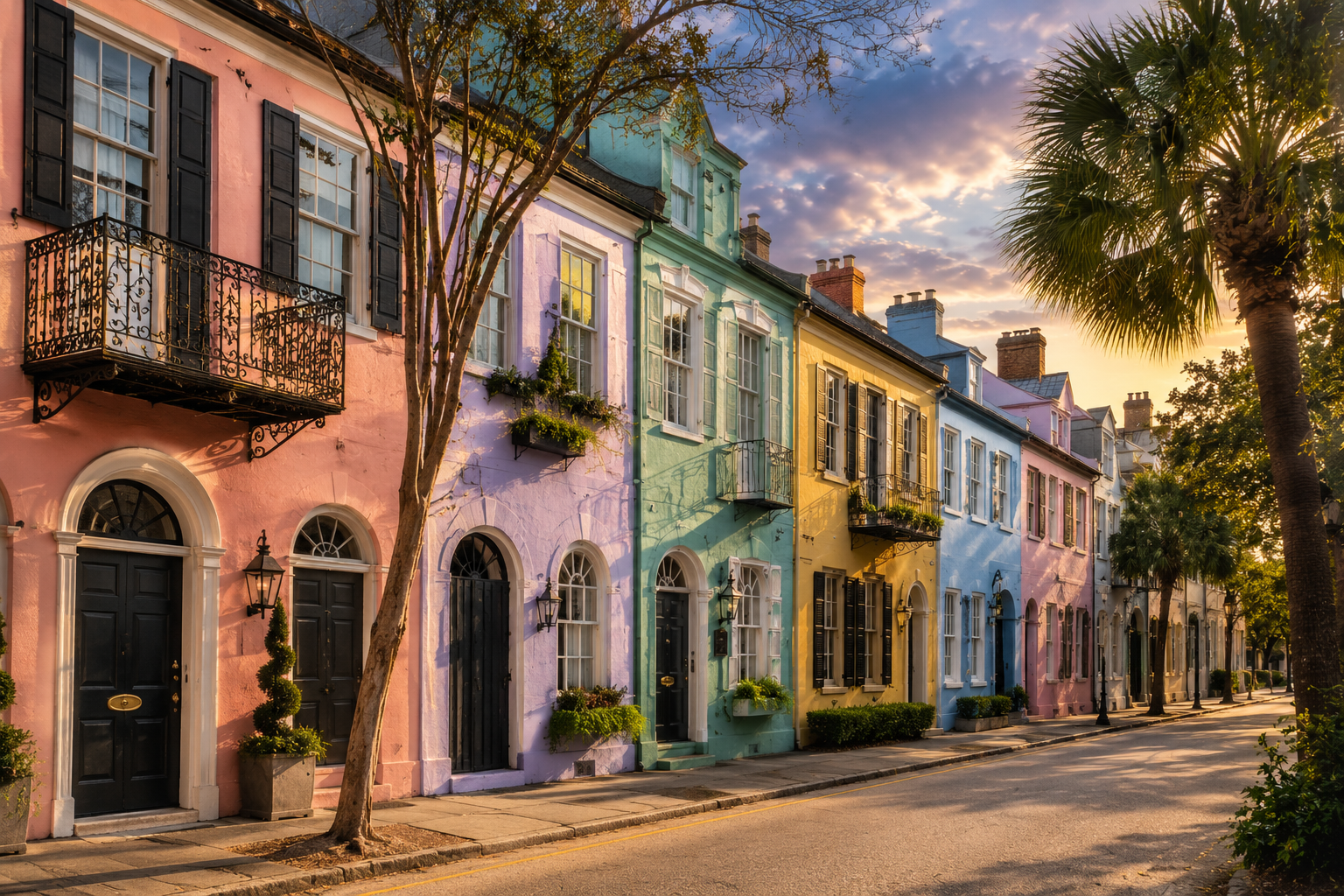
Rainbow Row is one of the most photographed locations in Charleston.
The famous stretch of colorful historic houses sits along East Bay Street near the waterfront. You do not need to purchase a ticket or join a tour to see it.
Because Rainbow Row is located between Waterfront Park and The Battery, it fits naturally into a walking route through Charleston’s historic district.
Remember that these are private residences. Enjoy the architecture and take photographs from the public sidewalk without entering private property.
Cost: Free
Best for: Photography and historic architecture
4. Visit Waterfront Park and the Pineapple Fountain
Charleston Waterfront Park stretches along the Cooper River and is one of the easiest places to enjoy Charleston without spending money.
Its best-known landmark is the Pineapple Fountain, which has become one of the visual symbols of the city.
The park also offers waterfront views, benches, shaded areas and long walking paths. From parts of the waterfront, visitors can see ships traveling through Charleston Harbor and look across the river toward Mount Pleasant.
Cost: Free
Best for: Families, couples, photography and waterfront views
5. Walk Through Charleston City Market
Charleston City Market is one of the most famous public spaces in the historic district.
Walking through the market itself costs nothing. Vendors sell artwork, crafts, food, souvenirs and traditional sweetgrass baskets, but purchasing something is optional.
Even if you do not plan to shop, the market is worth visiting because of its location and its importance to Charleston tourism and culture.
The surrounding Market Street area is also filled with restaurants, historic buildings and pedestrian traffic.
Cost: Free to enter
Best for: Local culture, browsing and people-watching
6. Walk Historic King Street
King Street is Charleston’s best-known shopping street, but walking it costs nothing.
The street cuts through much of downtown Charleston and passes restaurants, boutiques, historic buildings, hotels and antique shops.
Lower King Street brings you closer to the oldest portions of the city, while Upper King has become one of Charleston’s busiest dining and nightlife districts.
It is also one of the easiest streets to use as a north-south route while exploring downtown.
Cost: Free
Best for: Architecture, shopping districts and people-watching
7. Explore Charleston's French Quarter
Charleston’s French Quarter contains some of the densest historic architecture on the peninsula.
The neighborhood includes cobblestone streets, churches, galleries, historic buildings and narrow passages between Meeting Street and the waterfront.
Walking through streets such as Church Street, State Street and nearby sections of Broad Street can feel dramatically different from walking through a modern American city.
It is one of Charleston's best areas simply to wander.
Cost: Free
Best for: History, architecture and photography
You’ve seen the buildings. Now hear what happened inside them.
Charleston’s historic district contains centuries of stories involving death, tragedy, war, crime and alleged paranormal activity.
Ghost Tour Charleston explores the darker side of the city during an evening walking tour through historic Charleston.
8. Photograph Philadelphia Alley
Philadelphia Alley is a narrow pedestrian passage tucked between Queen Street and Cumberland Street.
The alley is short, but its brick walls, greenery and historic atmosphere make it one of Charleston’s most interesting hidden streets.
It is sometimes called Duelers Alley because of stories associating the area with Charleston’s dueling era.
Whether every legend attached to the alley can be proven or not, it remains an atmospheric place to explore.
Cost: Free
Best for: Hidden Charleston and photography
9. Walk the Arthur Ravenel Jr. Bridge
For one of the best elevated views of Charleston Harbor, walk the pedestrian and bicycle path across the Arthur Ravenel Jr. Bridge.
The enormous cable-stayed bridge connects downtown Charleston with Mount Pleasant.
You do not need to walk the entire bridge. Even walking partway up provides sweeping views of Charleston, the Cooper River and the surrounding harbor.
The climb also makes this one of the better free activities in Charleston for anyone who wants some exercise.
Cost: Free
Best for: Exercise, skyline views and photography
10. Visit Angel Oak Tree
Angel Oak is one of the most extraordinary natural landmarks in the Charleston area.
Located on Johns Island, the enormous Southern live oak is estimated to be hundreds of years old. Its massive limbs spread outward and downward, creating an almost cathedral-like canopy.
Angel Oak is outside downtown Charleston, so visitors will generally need transportation to reach it.
Access rules and operating hours can change, so check current information before making the drive.
Cost: Free
Best for: Nature and photography
11. Relax in Marion Square
Marion Square is a large public green space in the center of downtown Charleston.
It sits near King Street and several major downtown landmarks, making it an easy place to stop while exploring the city.
Depending on the time of year, the surrounding area may host markets, festivals and community events.
Even on an ordinary day, Marion Square provides a convenient break from walking Charleston’s historic streets.
Cost: Free
Best for: Relaxing and people-watching
12. Explore Hampton Park
If you want green space without the crowds of the historic district, head north to Hampton Park.
The park contains walking paths, lawns, trees and landscaped areas and is considerably larger than many of the parks visitors encounter farther south on the peninsula.
It is particularly good for walking, jogging, reading or having a picnic.
Cost: Free
Best for: Nature, exercise and picnics
13. Walk Around the College of Charleston
The College of Charleston campus sits directly inside the historic city.
Its combination of brick walkways, oak trees, historic buildings and gardens makes the surrounding area worth exploring while walking between King Street and other downtown neighborhoods.
Visitors should remember that this is an active college campus and respect any restricted buildings or areas.
Cost: Free to walk through publicly accessible areas
Best for: Architecture and photography
14. Explore Broad Street
Broad Street offers one of Charleston’s best concentrations of historic civic, religious and commercial architecture.
The intersection of Broad and Meeting Streets has traditionally been known as the Four Corners of Law because institutions representing municipal, county, federal and religious authority occupy the surrounding corners.
From here, visitors can continue toward the waterfront, Charleston City Hall, Washington Square and some of the oldest streets in the city.
Cost: Free
Best for: Charleston history and architecture
15. Visit Washington Square
Washington Square is a small park tucked behind Charleston City Hall near Broad and Meeting Streets.
Large trees and historic buildings surround the park, making it feel surprisingly secluded despite its location in the center of downtown.
It takes only a few minutes to visit, which makes Washington Square an easy addition to a self-guided walk through the French Quarter.
Cost: Free
Best for: History, shade and a quiet break
Looking for something to do in Charleston tonight?
Charleston changes after sunset.
Hear the darker stories connected to the streets you explored during the day with Ghost Tour Charleston, an evening walking experience through one of America's most historic cities.
Reserve your tour at GhostTourCharleston.com.
16. See Charleston's Historic Churches
Charleston has been nicknamed the Holy City because of the many church steeples visible across its skyline.
Historic congregations and church buildings can be found throughout downtown, particularly around Meeting Street, Church Street and the French Quarter.
Some churches occasionally allow visitors inside, while others may restrict access depending on services, events or operating hours.
Even from the public sidewalk, Charleston's historic churches are among the city's most impressive architectural landmarks.
Cost: Free to view from public areas
Best for: Architecture and religious history
17. Walk the Gateway Walk
Charleston's Gateway Walk connects a series of historic churchyards and gardens in the center of the city.
The route provides a quieter alternative to the major tourist streets and passes through spaces that many visitors overlook.
Because access to individual properties can vary, respect posted signs, operating hours and private areas.
Cost: Generally free in publicly accessible areas
Best for: Gardens, history and hidden Charleston
18. Explore Sullivan's Island
Sullivan's Island sits at the entrance to Charleston Harbor and provides a very different Charleston experience from downtown.
Visitors can walk the beach, explore the island's residential streets and enjoy views toward the Atlantic Ocean and Charleston Harbor without purchasing an attraction ticket.
Keep in mind that transportation and parking rules are separate from beach access itself.
Cost: Beach access is free
Best for: Beaches, walking and sunsets
19. Walk the Mount Pleasant Waterfront
Across the Cooper River from downtown Charleston, the Mount Pleasant waterfront provides excellent views back toward the Ravenel Bridge and Charleston Harbor.
This area works particularly well when combined with a Ravenel Bridge walk.
It also gives visitors a chance to see Charleston from the opposite side of the Cooper River rather than spending the entire trip downtown.
Cost: Free
Best for: Harbor views and walking
20. Simply Wander South of Broad
Sometimes the best free thing to do in Charleston is simply walk.
The South of Broad neighborhood contains some of the city's most remarkable residential architecture, gardens, ironwork, narrow streets and historic homes.
Try walking portions of Church Street, Meeting Street, Tradd Street, Legare Street and the streets surrounding The Battery.
There is no admission fee because you are simply exploring Charleston's public streets and sidewalks.
Just remember that these are residential neighborhoods. Stay on public property and respect the people who live there.
Cost: Free
Best for: The quintessential Charleston experience
Best Free Charleston Walking Route
If you only have a few hours, several of Charleston's best free attractions can be combined into one downtown walking route.
Start around Charleston City Market, walk through the French Quarter, continue toward Waterfront Park and the Pineapple Fountain, see Rainbow Row, continue south to The Battery and White Point Garden, then loop back through the historic streets of South of Broad.
That route covers many of Charleston's most recognizable landmarks without requiring an admission ticket.
Wear comfortable shoes. Charleston's sidewalks, bricks, cobblestones and uneven historic surfaces can make several miles of walking more tiring than expected.
Best Free Things to Do in Charleston at Night
Charleston is especially atmospheric after sunset.
King Street, Waterfront Park, The Battery, Market Street and many public streets throughout the historic district can still be explored in the evening, although individual parks, attractions and properties may have their own hours.
For visitors interested in Charleston's darker history, nighttime is also when the city's ghost stories begin to make considerably more sense.
Take a Charleston Ghost Tour After Your Free Day of Sightseeing
You can see Charleston for free.
But seeing Charleston and understanding the stories behind Charleston are two very different experiences.
After spending the day walking past centuries-old homes, churches, alleys and graveyards, join Ghost Tour Charleston for an evening journey into the city's darker history.
Charleston has survived wars, epidemics, fires, hurricanes, murders, executions and more than three centuries of human drama. Those events left behind stories that aren't obvious when you simply walk past the buildings.
Ghost Tour Charleston brings those stories into the streets where they happened.
Learn more and reserve your Charleston ghost tour at GhostTourCharleston.com.
Frequently Asked Questions About Free Things to Do in Charleston
What are the best free things to do in Charleston, SC?
The best free attractions in Charleston include The Battery, White Point Garden, Rainbow Row, Waterfront Park, the Pineapple Fountain, Charleston City Market, King Street, the French Quarter, Angel Oak Tree and the Arthur Ravenel Jr. Bridge.
Can you explore downtown Charleston for free?
Yes. Many of Charleston's most famous landmarks can be seen from public streets, sidewalks and parks without purchasing admission. Downtown Charleston is particularly well suited to walking because many major attractions are relatively close together.
Is Rainbow Row free?
Yes. Rainbow Row can be viewed for free from the public sidewalk along East Bay Street. The houses themselves are private property.
Is Charleston City Market free?
Walking through Charleston City Market is free. Visitors only spend money if they choose to purchase food, artwork, crafts, souvenirs or other goods from vendors.
Is Waterfront Park free?
Yes. Charleston Waterfront Park and the famous Pineapple Fountain can be visited without purchasing an admission ticket.
Can you walk The Battery for free?
Yes. Walking along The Battery and visiting adjacent White Point Garden are free.
What can you do in Charleston without a car?
Visitors staying downtown can reach many attractions on foot, including Charleston City Market, King Street, Waterfront Park, Rainbow Row, the French Quarter, The Battery and White Point Garden.
What is the best free thing to do in Charleston for first-time visitors?
A walking route from Charleston City Market through the French Quarter to Waterfront Park, Rainbow Row, The Battery and White Point Garden provides an excellent introduction to Charleston.
What is there to do in Charleston at night?
Visitors can explore areas of downtown Charleston, enjoy restaurants and nightlife around King Street, walk portions of the waterfront and take an evening ghost tour.
For travelers interested in history, storytelling and Charleston's supernatural legends, Ghost Tour Charleston offers an evening walking tour through the historic city.
Explore Charleston by Day. Discover Its Ghosts by Night.
Charleston is one of those rare cities where simply walking around can be an attraction.
Spend the day exploring its waterfront, parks, architecture, markets and historic streets.
Then, when the sun goes down, discover the Charleston hiding beneath the beautiful photographs.
Ghost Tour Charleston takes you into the stories of the people, tragedies and legends that helped create one of America's most famously haunted cities.
Book your evening ghost tour at GhostTourCharleston.com.